
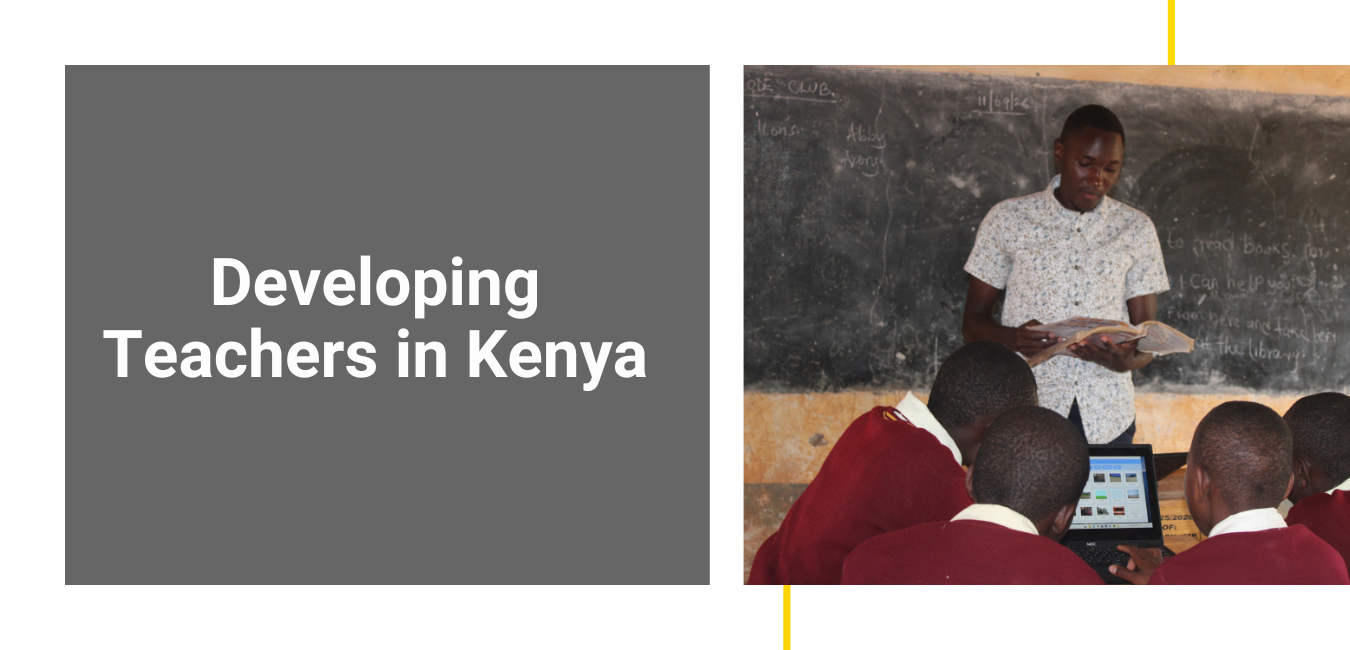
Transforming classroom pedagogy through Teach2030 and school based professional learning communities in Kenya with Kenya Connect
KEY EDUCATION CHALLENGES IN KENYA
- Inequitable TPD Access: Rural and underserved teachers have limited or insufficient access to regular, practical TPD opportunities due to high costs and unequal resource allocation, despite national policy mandates.
- Low Foundational Literacy Levels: Student underachievement persists, with many struggling to read, write and comprehend English at expected grade level: only 42% of Grade 3 students meet numeracy thresholds and 53% English thresholds. This is complicated further by differences between home languages and teacher instruction.
- Limited Access to Resources: Schools face deficits in textbooks, instructional materials, digital devices and content. Digital infrastructure and internet connectivity can also be unreliable, affecting teachers’ professional learning and varying levels of experience/confidence in using digital technologies.
- Overcrowded Classrooms: Class sizes frequently exceed 100 students—far above the government’s recommended 35–40 limit—making safe learning environments, differentiation, student inclusion, and behaviour management extremely challenging.
Prior to beginning our partnership, Kenya Connect teachers cited difficulty engaging large classes, limited digital skills, and a lack of variety in teaching methods as their main problems. Lesson preparation and awareness of online safety issues (data loss, hacking, cybercrime) were also mentioned.

THE PARTNERSHIP
The Kenya Connect-Teach2030 Professional Learning Community (PLC) Programme is a school-based TPD initiative involving 26 teachers in 3 schools (Katangi Comprehensive School, Kilaatu Comprehensive School and Mand’olota Primary School – changed annually). It combines Teach2030 online professional learning with school-based classroom application, peer learning, feedback and ongoing support.
Kenya Connect provides on the ground introduction, overview, contextual relevance and orientation of the Teach2030 platform, as well as ongoing support. Teachers undertake courses independently (Practical Active Learning and Becoming a Digital Learner), at their own pace. They meet once every week to discuss what they have tried in their classrooms, what worked, the challenges encountered and possible ways to improve practice. These PLCs provide additional support and this collaborative environment allows teachers to learn both from Teach2030 content and from each another: teachers can ask questions, clarify concepts and connect online learning to their classroom. This tailors Teach2030 to the specific needs and realities of teachers in the participating schools.
Kenya Connect summarises the ongoing model as a continuous improvement cycle:
Learn → Discuss → Apply → Reflect → Improve → Share
Teach2030 provides access to flexible professional learning whilst teachers can remain in their schools, continuing with their normal teaching responsibilities. Teach2030 provides practical, professional learning that enables teachers to reflect on their classroom practices and strengthen their pedagogical approaches. The programme therefore complements Teach2030 learning with school-based support in digital skills and ICT integration, enabling teachers to develop practical skills that they can apply in their daily work.’
Kelvin Misoga, Quality Education Co-ordinator, Kenya Connect

IMPACT AND VALUE OF THE PROGRAMME
Whilst 142 users are currently registered, it is those working in PLCs who have the highest course completion rates due to the structured approach of online learning, face-to-face engagement, classroom application and peer learning.
All teachers report improvements in their own teaching skills, digital skills, and their students’ outcomes resulting from the partnership:
- Confidence and pedagogy. Teachers describe becoming more intentional and varied in how they deliver lessons, and several specifically note a boost in confidence and professional experience.
- Student outcomes. Classroom strategies introduced are practical and learner-centred (‘Turn Talk,’ ‘Thumbs Up,’ and group work) that teachers say are improving student engagement, self-expression, confidence, and grades. Several specifically mention students becoming more willing to ask questions, participate, and work independently.
- Digital capability. Multiple teachers say the programme directly improved their ability to use digital devices to plan, project, and deliver lessons.
Meeting the demands of the 21st century world calls for upskilling teachers’ pedagogical and technological needs to equally match the dynamism of the world. With this partnership, educators can compare notes, seek clarification, learn and find practical solutions to various challenges they encounter while executing the noble duty of impacting the future.
Rebecca Akinyi Migwambo

LOOKING AHEAD
Moving forward, teachers have identified several key priorities, all of which are logistical — network connectivity, data costs, and device access — rather than related to course content. We are working together and strengthening connections to ensure all teachers can access courses effectively.

WHY THIS MATTERS
Meanwhile, Kenya Connect is providing a visible, in country presence of the Teach2030 TPD in action.
The Kenya Connect-Teach2030 PLC Programme provides a practical approach to improving teacher professional development in Kenya.
By combining Teach2030 online courses with weekly PLC sessions, the programme ensures that professional teacher development translates into improved teacher practice and, ultimately, better learning experiences and outcomes for students.
Want to make a difference in your community? Email [email protected]
