

As teachers, we can stand at the front of the class and assume that just because we are teaching, students are learning. But is this really true? When we teach, are we really sure that students are taking in the information and applying the skills that we want them to?
We are used to doing summative assessment, and, quite often this is set for us by a member of leadership or national examinations. Summative assessment happens at the end of a topic, course or part of a curriculum. It is a final judgement that must be done at a specific time and place. This might take the form of an exam, test or a project. There’s no denying that summative assessment is formal. It will affect students’ final grades and any reports written to parents/carers.
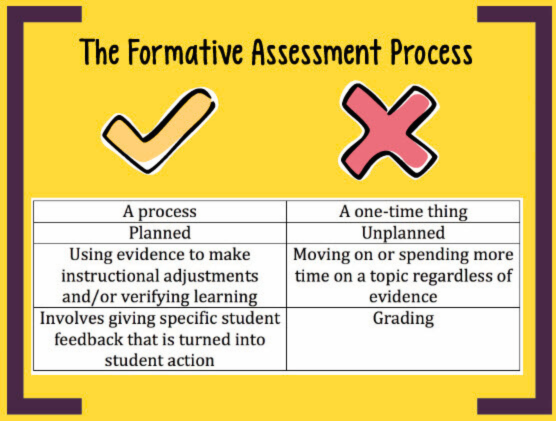
Formative Assessment is very different. In fact, it is the complete opposite! Instead, it is used throughout and within a course or curriculum. It is ongoing and focuses on improvement. It happens every lesson, and it is informal, so students’ grades or reports. It is a safe space for students to share what they know. It is also a way of getting information about what students can do, so that teaching can adapt to improve their knowledge and skills.
Formative assessment is a great way to track how students are doing. It answers that big question: what do they know and what can they do? From here, it’s easy to work out where the gaps are in knowledge or skill. Students find it motivating, as they feel empowered and more in control. For teachers, it can be hard when our students clearly tell us that they don’t get something, but this isn’t a criticism, but a way of improving planning.
Our Formative Assessment course focuses on 7 different formative assessment strategies to try in the classroom. Some of these are really quick and easy to use, but can revolutionise a classroom. With no extra resources needed, they are also applicable to any classroom. Whilst it does need planning, it will save time in the long-run, as it helps to know what to teach next.
So, why not give it a go and try our new course today?
Finally, share your favourite formative assessment strategy beneath!
